
|
Fun Time
Purpose. To make a model of an elbow.
Materials. Small box with lid, masking tape.
Procedure.
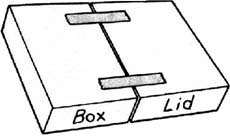
- Place the box and lid together on a table with their open sides down.
- Connect the box and lid with two strips of tape as shown.
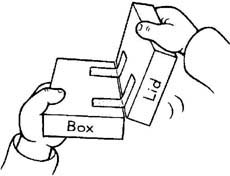
- Hold the box with one hand and raise the lid with your other hand.
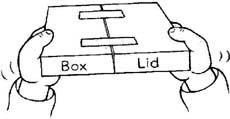
- Hold the box with one hand and lid with the other hand. Try to bend the lid down.
So Now We Know
The combined box and lid represent an elbow. The box represents the bone in your upper arm and the lid is the bone in your lower arm. The tape pieces are ligaments that hold bones together. Where the two boxes meet represents a joint. Since the box can only bend in one direction, the joint is a hinge joint.
This experiment was taken from Janice VanCleave's Play and Find Out About the Human Body and used by permission of the publisher, John Wiley & Sons, Inc.
For more information about joints, check out Janice VanCleave's Human Body for Every Kid (ages 8-12) and Janice VanCleave's Super Science Models (ages 8-12).
|
Q: Why does my elbow only move in one direction and my head moves all around?
A: There are more than 200 bones in your body. The place where bones meet is called a joint. Some joints, such as your elbows, can only move in one direction. Your head can move in many different directions because it is attached to your neck which has different types of joints.
Before birth, a human baby's skeleton is made of cartilage (a tough, rubbery flexible tissue that is sometimes called gristle). But by birth, most of the cartilage has changed into about 350 bones. As the baby grows, many of these bones grow together. An adult skeleton has about 206 bones. Cartilage still makes up some parts of the adult skeleton and keeps some bones, such as those in your knees, from rubbing together.
Where bones come together is called a joint. Some are fixed joints, which allow no movement, such as the bones of the skull. Other joints are slightly moveable joints, as are the joints in your spine. But most joints are moveable joints, meaning they are able to move freely, such as your elbow or knee. A tough band of slightly elastic, fibrous material called a ligament connects bones at joints.
Your elbow, knee, and the knuckles of your hand are examples of a moveable joint called a hinge joint. This joint allows only back and forth movement, like a door swinging on its hinges. The elbow allows the bones of the lower arm to be raised and lowered. In the elbow, the rounded end of the humerus bone of the upper arm fits into a cradle formed by the ulna and radius bones of the forearm. "I hit my funny bone!" is often said when the elbow is hit. But it is not the humerus bone that causes the not-so- funny tingling sensation. Instead, it is a nerve that is close to the surface that causes the pain when knocked against the humerus bone.
Your head is connected to your neck, which is the top seven of the 26 bones of your spine called vertebrae. In between the vertebrae are disks of cartilage. It is the cartilage between the vertebrae that allows the spine to bend and twist somewhat. Thus the joints between the vertebrae are considered slightly moveable joints. The first vertebra of your neck is different in that it can move up and down. The flexibility of this vertebra, called the atlas, allows you to move your head upward or downward, such as when you look up at the sky or down at the ground.
A moveable joint, called a pivot joint, is between the first and second vertebrae of your neck. Pivot joints allows rotation but not up and down movement, so the pivot joint in your neck allow you to turn your head left and right. Place your hand on your neck as you turn your head and you'll discover that only the upper part of your neck is turning. The flexibility of the cartilage disks between the remaining five neck vertebrae allows you to tilt your head to the side and crane your neck backwards and forward.